
Your Weekly Dispatch is Here
A new Portuguese law banning face coverings has drawn international criticism, while women in Iran continue to face lashes and arrest for appearing without hijab. Together, these stories raise a broader question: what does it really mean to "choose" religious dress under systems that punish those who refuse it?
Unbelief Brief
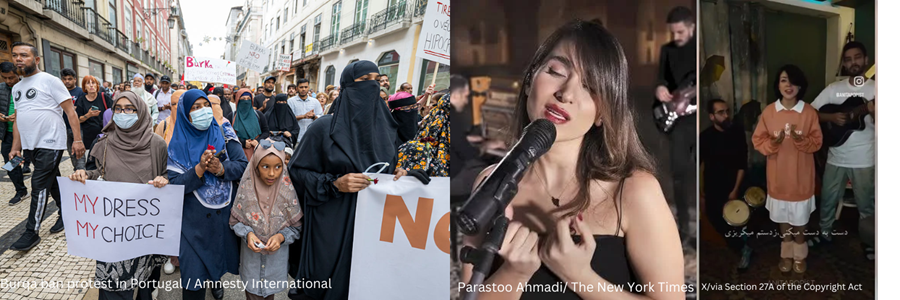
The Portuguese Parliament has passed a law banning face coverings in all the country’s public spaces. Though it is colloquially called the “burqa law,” explicit references to Islam were removed from the final draft, which simply prohibits completely covering one’s face in public. While organizations like Amnesty International are correct in their condemnation of the larger chilling effect and privacy concerns, their characterization of the move as a violation of the human rights of Muslim women who “choose” to cover their face is somewhat reductionist.
While we believe that banning face coverings entirely is the wrong approach, the discourse around this topic has again failed to capture the nuance of the issue. There are genuine security concerns related to identifying criminals, which has always been the tension between individual rights and order. We and most of the Western world have weighed on the side of individual rights in the past. As Ben Franklin opined: "Those who would give up essential Liberty, to purchase a little temporary Safety, deserve neither Liberty nor Safety."
There is also the larger conversation of what it means to “choose” the burqa or niqab. How many women grow up in a culture that allows them to wear what they please, show their face openly, and wear their hair down, and later choose to join a repressive culture that denies them all of this? The range of human behavior is wide and fascinating, but this psychological profile is a rare one.
In almost every instance, women who cover their face are not “choosing” to do so in the way a woman might choose to cut her hair or style it in a certain way. They are taking on a “religious obligation” that was drilled into them from birth in a system directed by male authority figures. They have likely heard stories, digested commandments from their “God,” or seen firsthand what happens when women try to remove these garments and live freely: they are ostracized at best or killed at worst.
“The idea that if you only have one effective choice and if you cleave to that choice, and you walk around and say "it's my free choice," "I would've chosen that anyway"—it still doesn't speak to what would happen if you would've chosen otherwise.” - ex-Muslim Hiba on head coverings
Portugal’s approach may be ill-conceived, but it is right and healthy to desire an end to this system of patriarchal oppression.
The impulse to keep women’s heads and faces covered finds its clearest expression in places like Iran, where not one but two women have been sentenced to 74 lashes in the past month on public indecency charges—simply for posting videos of themselves online singing without hijab. Iran may not force its women to go about in full burqa or niqab like the Taliban, but its mandatory headscarf regulations come from the same place: desire for control over women. This state of affairs is still not cruel enough for some clerics. One such cleric, named Mohammad Reza Naseri, recently expressed the view that the current adherence to hijab in the country is “unacceptable,” as far too many women openly flout the regulation, particularly in Tehran and other large cities.
The “choice” framing ultimately fails to consider the right of women not to be coerced into dressing in ways they would otherwise reject—nor the right of women not to be punished for choosing something their religion disallows. That is the true meaning of the hijab, the burqa, and the niqab: submission to male authority.
Until next week,
The Team at Ex-Muslims of North America
P.S. We’d love to hear from you! Share your feedback at [email protected].