
Greetings, Dissenters
This week’s Unbelief Brief moves between two scenes: a suicide bombing at a Shia mosque in Islamabad claimed by ISIS, and a familiar round of “Sharia law” warnings from Texas politicians. One reveals the lethal consequences of sectarian zealotry. The other highlights a more familiar pattern at home: religious supremacy remains the throughline in politics. Religious freedom isn’t a privilege reserved for the majority faith, whether Christianity in America or Islam in the Middle East—it applies to everyone, or it isn’t freedom at all.
And in this week’s Guest Dispatch, Mubarak Bala returns to reflect on the real-world cost of policing belief.
Unbelief Brief
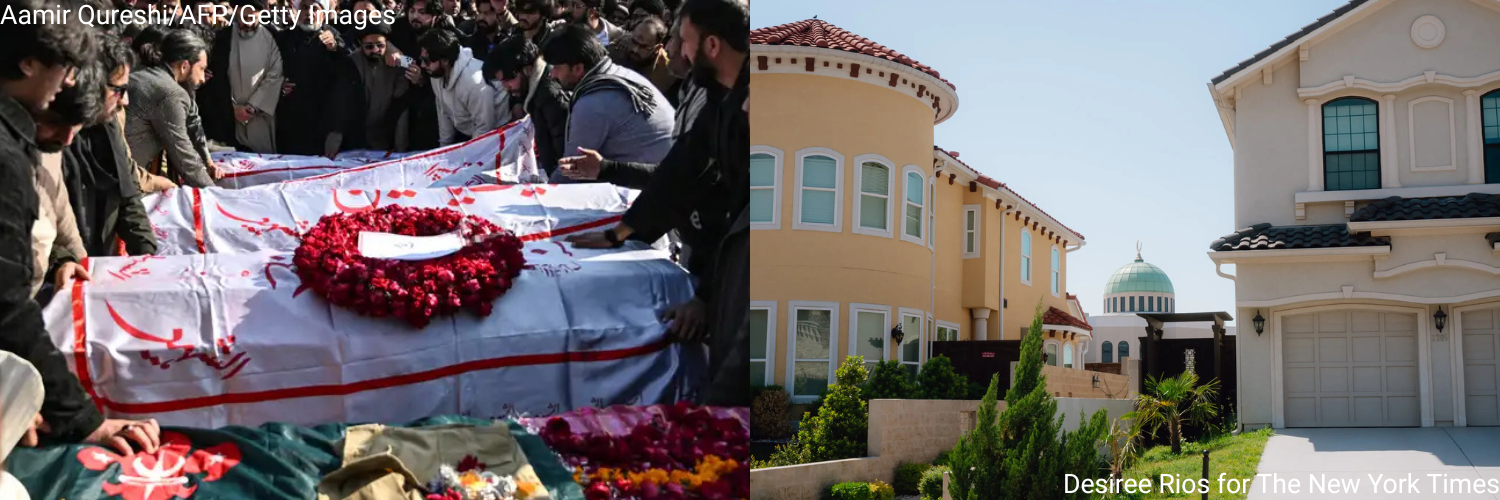
The deadliest terror attack in Pakistan since 2023 once again reveals the brutality of militant Islam. On Friday, February 6th, a lone man opened fire against security personnel at a Shia mosque in the capital of Islamabad. The assailant then entered the mosque, where his suicide vest detonated. At least 32 were killed with approximately 170 additionally injured. No terror attack of comparable scale has occurred in Islamabad since 2008.
Pakistan’s regional ISIS affiliate claimed responsibility for the attack, painting it as divine justice against “infidel” Shia Muslims. That the attack targeted fellow Muslims only exemplifies the inhumanity of Islamic fundamentalism. There will always be disagreements about theology and law among the adherents of any religion, but zealotry demands no compromise. Militant Islam actually hurts Muslims more than others, and it does so by design. They are the primary victims of their own religion’s violence.
Meanwhile, in the US, Texas political leaders perceive a threat to their own preferred brand of theocracy. Warning against the imminent dawning of “Sharia law,” they seem prepared to exploit the growth of the state’s Muslim population as a political lightning rod. This has already been seen in Governor Abbott’s previous declaration that the Council on American-Islamic Relations (CAIR) is a terrorist group. Now, lawmakers are back to centering their ads around the threat of “radical Islam” and promising performative “bans” on Sharia law.
As mosques begin to “dot a landscape once dominated by megachurches,” a conversation about the implications of the state’s changing religious landscape could be productive and even necessary. EXMNA has long sought to remind well-meaning liberals that many Muslims do not share their values. They are, by and large, social conservatives who believe in regressive family values, subordinate roles for women, and many oppose homosexuality. But ironically, this would make them natural allies of conservatives if not for the accident of their religion.
Guest Dispatch

Nigeria’s Muslim-majority north accounts for the vast majority of the country’s dysfunction—socially, economically, and otherwise.
Northern Nigeria is the poverty capital of the world. Some 12 million children aged 5 and above participate in the centuries-old Almajiranci system of Islamic education, studying the Quran under a tutor and begging for food on the streets during the remaining hours of the day. With rates of literacy and formal schooling well below 50%, the Hausa-Fulani-Kanuri women of the Sahel region are among the least educated on the planet, having their first children at an average age of 14 with a fertility rate of up to 6.5.
The north’s pervasive poverty exists in a context of widespread violence and brutality. The reintroduction of Islamic Sharia to northern Nigeria at the turn of the millennium triggered a massive orgy of killings, primarily of Christians, which only concluded with the formation of Boko Haram and the advent of mainstream jihadi terrorism. That insurgency still rages, and militia kidnappings for ransom now constitute a million-dollar enterprise.
These conditions predictably give rise to massive social problems. For example, child marriage and child abuse are so endemic in northern Nigeria that enforcing the Constitution’s provisions against these practices is effectively impossible. A political leader responsible for enforcing these laws could be a 60-year-old man with a pregnant 16-year-old bride at home. In 2010, for example, Senator Ahmad Sani Yerima defended his marriage to a child bride smuggled in from Egypt, declaring that his God and his Prophet’s example allow it.
At a more systemic level, economic dysfunction undergirds the north’s dire state of affairs. The region’s mainstay, agriculture, remains subsistent and primitive. Without Nigeria’s federal security apparatus and the oil resources of the south—accounting for some 90% of the country's income—the north would have long outmatched the Taliban’s Afghanistan in its adherence to Sharia. It would have outmatched 1990s Somalia in terms of state failure, 1990s Ethiopia in terms of food insecurity and hunger, and 1990s Rwanda in terms of ethnic conflict and genocide.
If not for the semblance of structure supported by the oil economy, the region’s 120 million inhabitants would likely have descended into a state of pure anarchy. Any remedy to this situation is likely to be measured in years, if not decades. And it will require that Nigeria undergo a process of secularization—something that, while not easy, may be possible if the will to achieve it is there.
Until next week,
The Team at Ex-Muslims of North America
P.S. We’d love to hear from you! Share your feedback at [email protected]