
Thanks For Being Here
This week’s edition of Dissent Dispatch traces a widening fault line: what happens when governments yield to religious authority instead of defending secular principles. In Turkey, state-mandated Ramadan activities in schools spark backlash from those warning that secularism itself is under siege. In Australia, Islamist-inspired violence against LGBT teens exposes the human cost of fundamentalist ideology. And in the United States, the normalization of Christian theocratic voices at the highest levels of power signals that this challenge is not confined to any one faith or region.
Our final Guest Dispatch installment from Mubarak Bala brings the stakes into sharp focus, warning that without reform and resistance to extremism, entire nations can be pushed toward collapse.
Unbelief Brief
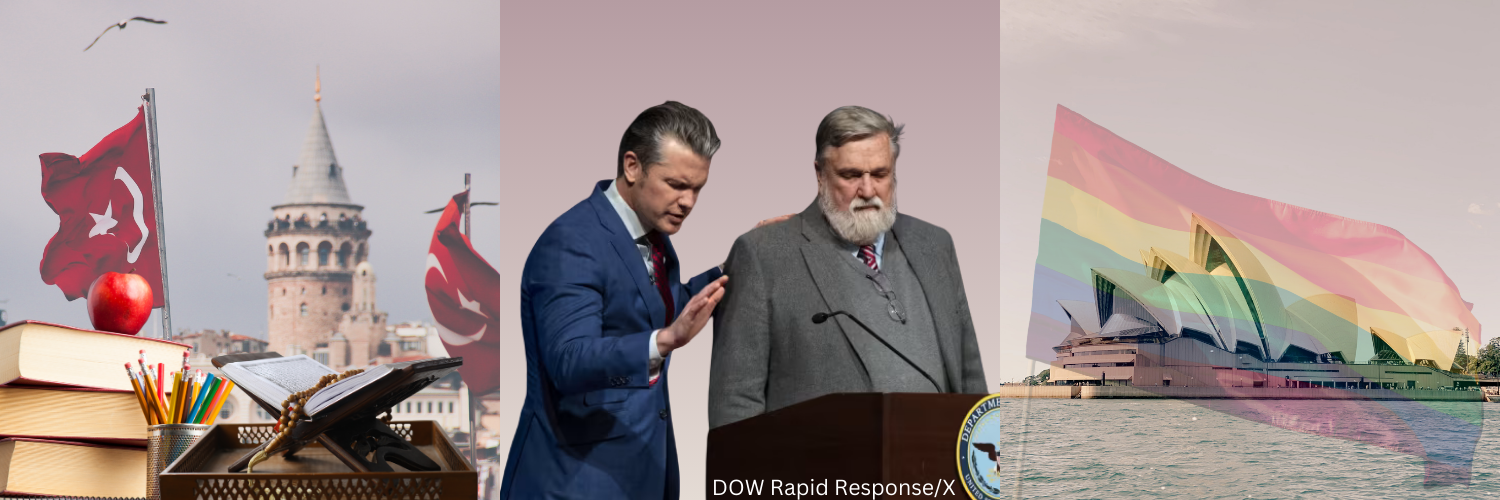
The Turkish government has issued a directive ordering schools across the country to organize “religious activities” during the month of Ramadan. Such a move, blurring the lines between mosque and state, is completely unsurprising from Erdogan’s government. It was followed by the publication of a manifesto from “writers, artists, academics, journalists, lawyers, educators and representatives of professional associations,” who see secularism in Turkey threatened by “reactionary” forces. Of course, Erdogan’s quasi-Islamist government is not content to allow criticism to go unpunished. Yusuf Tekin, the Minister of Education who issued the order, is now suing 168 of the highest-profile signatories of the petition against the directive, promising: “We will see who is reactionary and bigoted.”
Meanwhile: Australian police are investigating a series of brutal assaults against gay and bisexual teenagers in the Sydney area over the last two years. Many of the assailants, who are largely Muslim, reportedly took inspiration and influence from hardline Islamist preachers like Wisam Haddad, who also inspired the recent Bondi Beach massacre. Text messages from the attackers who organized the assaults, along with video that has circulated, confirm the religious motivation of the beatings and the assailants’ sympathy with Islamic State (IS) ideology. While calls push back against homophobia are welcome, it is vital to understand where this homophobia is coming from: namely, Islam itself, which has condemned homosexuality for more than a thousand years and prescribes brutal punishments for it—corporal punishment at best, summary execution at worst.
Finally: US Secretary of Defense Pete Hegseth recently hosted Doug Wilson, a fundamentalist pastor open about his desire for Christian theocracy in America, at the Pentagon. Hegseth has refused to push back against any of Wilson’s ideas, which include the repeal of the 19th Amendment and a full-throated defense of patriarchal social structures. While reports indicate that the content of the sermon Wilson delivered was largely apolitical, the legitimization of such a figure from the nation’s top military official is deeply alarming. This is especially true in the wake of continued secular backsliding in states like Louisiana, where an appeals court has just ruled that, for the time being, the state may mandate the display of the Ten Commandments in every public school classroom.
Guest Dispatch

Mubarak Bala, president of the Humanist Association of Nigeria, spent nearly five years behind bars on a blasphemy charge over a Facebook post. Now free, he warns that without constitutional reform and a decisive stand against religious extremism, Nigeria’s promise of secular governance will remain out of reach.
Over the years, efforts by the Nigerian government—from kinetic military actions to economically empowering the youth, from preaching tolerance to encouraging loyalty to the Constitution—may have saved Nigeria from a trajectory of certain doom. Or perhaps they have only delayed it: Islamists have employed their own efforts, and conspiracy theories that Western governments prop up jihadists contributed to the recent expulsion of the French and the Americans from the Sahel. As the insurgency encroaches further into northern Nigeria, the exit of the Western militaries and their intelligence-gathering capabilities has left Nigerian forces at a serious disadvantage. Mass casualties and loss of territory to the more motivated jihadists follow.
Meanwhile, residents of small towns and villages choose safety over loyalty to the state. Arbitrations and tax levies imposed by the jihadists in the region, including northern Nigeria, are respected and obeyed. Those who resist learn what jihad means. Just this month in Kwara State, terrorists massacred some 200 men in a village square, while some 200 women and children were taken as war booty, just as the Qur’an commands. The citizens are now so traumatized that they would rather offer fealty and become informants to terrorists than live under an increasingly impotent state government. It may be only a matter of time before the terrorists proclaim a new caliphate and attempt to secede from Nigeria.
All the while, secularists from exile, and those in hiding, keep writing. We keep the advocacy alive, bringing these reports to the world stage—but attention is elsewhere. If the world media continues to ignore the situation, news of collapse could come like a bomb, an explosion with global reverberations. For a country of some 250 million people to fail, or for the broader region to become ungovernable, would force the world to grapple with a refugee crisis potentially in the hundreds of millions.
At least we secularists and humanists from the region, whether alive or dead when the time comes, could say we tried our best to warn of this catastrophe, or to reform our countries from within. But global apathy is a difficult problem. “After all,” the developed world might ask, “what more is to be done for the sub-Saharans? We ended slavery, abolished apartheid, introduced world bank initiatives and democracy, printed their currency, bought their oil, sold them weapons, and left them to their own cultural heritage.”
Perhaps this is true. But that cultural heritage included the problem of religious delusion. Uninformed that there are neither gods nor life after death, we used all the resources we could muster to buy ourselves the next life as we imagined it to be: flying beds, green gardens, sex orgies with minors, and copious liquor. Perhaps in the end, we will have destroyed ourselves in our quest to reach this, Allah’s imagined paradise.
Until next week,
The Team at Ex-Muslims of North America
P.S. We’d love to hear from you! Share your feedback at [email protected].