
Your Dispatch Is Here
This week’s Unbelief Brief begins in Iran, where Ali Khamenei’s death has not brought the Islamic Republic any closer to reform. Power has instead passed to his son, Mojtaba Khamenei—a sign that the regime’s theocratic continuity remains firmly intact. We then turn stateside to an ISIS-inspired attack attempt targeting anti-Muslim protestors and the reluctance of some early coverage to clearly describe what motivated it. We close with a rare piece of good news: despite a new law allowing prayer times in public schools, most Texas districts have declined to implement them.
In EXMNA Insights, we present the second installment in our “Women Islamic History Couldn’t Contain” series. This week highlights Shajar al-Durr, the former slave who briefly ruled Egypt in 1250 before being forced from power because a woman on the throne was deemed incompatible with the words attributed to the Prophet Muhammad. Artwork by Musawwir.
Unbelief Brief
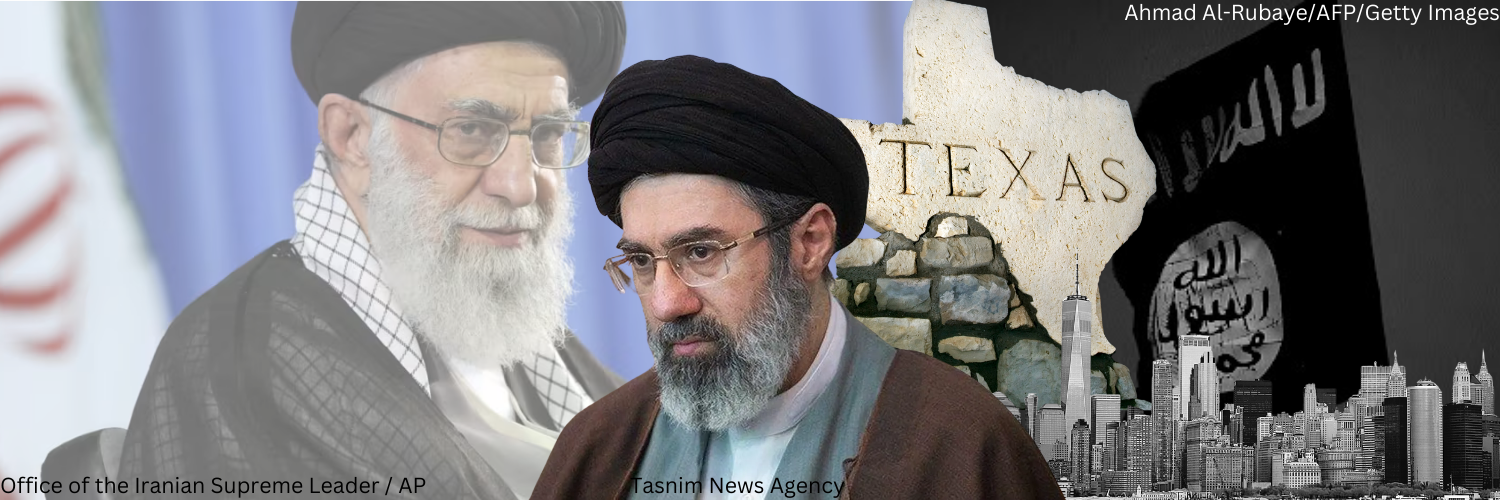
The late Supreme Leader of Iran, Ali Khamenei, has a successor: his son, Mojtaba. While the US and Iran remain at war and nothing is settled, this is not good news for anyone who cares about Iranians’ freedoms. The late ayatollah’s son has been unflinchingly loyal to the Islamic Republic and its principles since the success of the Islamic Revolution, when he was just ten years old. Rather than an end to the “old regime,” this constitutes theocratic continuity. The new ayatollah will undoubtedly be more hardline, particularly after his father, wife, and child were killed in the war. He is reputed to be even more uncompromising in his theocratic vision than his father. Those who long for a free, secular, and democratic Iran can only hope that his tenure is not long.
The women of Iran’s soccer team who opted not to accept asylum in Australia will thus return to a country whose rulers are thirstier than ever for vengeance. The team recently competed in the 2026 Asian Cup in Sydney, refusing to sing the Iranian national anthem before their first game. No one on the team has publicly stated why they remained silent, and the team sang and saluted the anthem at subsequent games. State media, nonetheless, was quick to brand them “traitors” who required severe punishment. In Iran, this can easily mean execution; at a minimum, the returning women are likely in serious physical danger.
It is possible the women refused to sing before their first game as an act of protest and were subsequently coerced into changing their behavior. They have reportedly been under serious pressure to return to Iran, as state officials urge their homecoming. Some footage has appeared to show Iranian “handlers” “hunting down” members of the team.
It’s been reported that “six team members and one staff member” have chosen to accept humanitarian visas from the Australian government, while a seventh team member initially accepted but appeared to change her mind at the last moment. The rest of the team, at least some of whom were reportedly not offered asylum over potential ties to Iran’s Revolutionary Guard, are returning. But worrying footage showed “a woman being led by the wrist by a teammate to the bus bound for the airport,” suggesting that not every one of them is returning to Iran willingly.
Stateside, two young men—Ibrahim Kayumi and Emir Balat—have been arrested and charged with terrorism after apparently attempting to hurl explosive devices into a crowd of “anti-Muslim” protestors. The two appear to have been inspired by ISIS. However, following the initial coverage on the day of the attack—whether in statements from news outlets or from the mayor’s office—one could be forgiven for not knowing this. Much of the coverage seemed to tiptoe around who the perpetrators were and what motivated them. Regardless, what happened is not a mystery, and this has since been corrected. Mayor Mamdani’s follow-up statement condemning the attack for its ISIS-inspired nature was welcome. The two men can hopefully look forward to a very long stay in prison.
Lastly: the Texas Tribune reported last week that the vast majority of Texas public schools have opted not to include prayer times during the school day. This is excellent news. All Texas school districts have the right to set aside time for prayer in public schools as of last year, when Senate Bill 11 was passed. That so few have done so is a sign that there is still some bedrock for American secularism, even in very conservative states. Nonetheless, we believe that allowing sanctioned prayer times in public schools is patently unconstitutional. Texas schools remaining largely secular is good news, but a real victory would be to see Senate Bill 11 struck down.
EXMNA Insights: Women Islamic History Couldn’t Contain
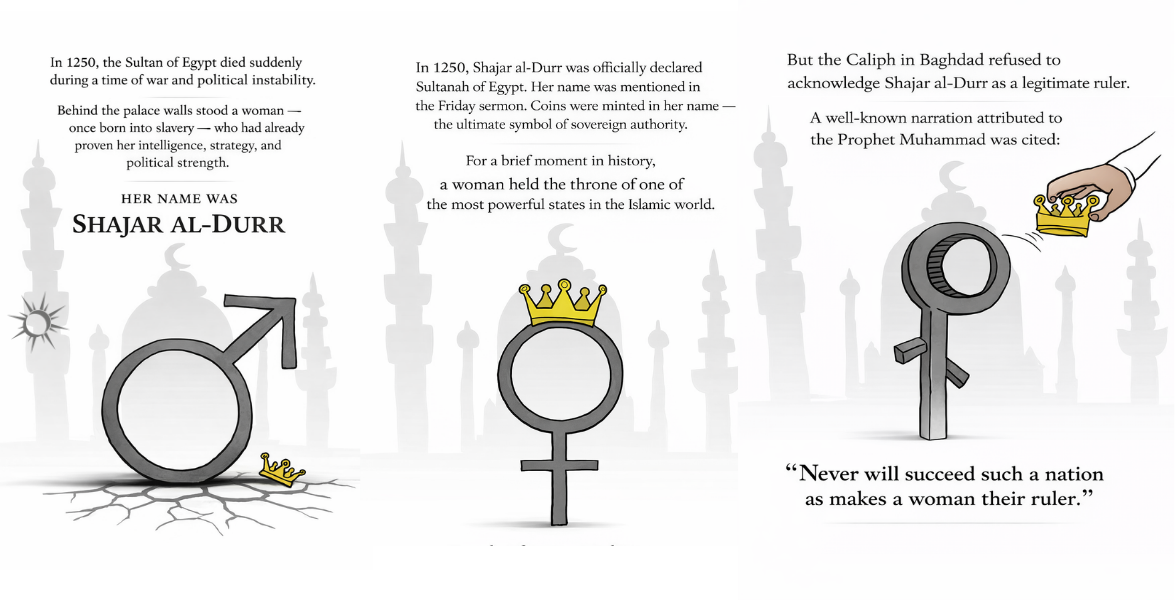
Artwork by: Musawwir
“Never will succeed such a nation as makes a woman its ruler.”
This sentiment from none other than the Prophet Muhammad himself, recorded in various hadith, well exemplifies the patronizing and condescending attitude of Islam toward women. But it hasn’t stopped some women throughout history from attempting to exercise their right to rule, even as devout Muslims. One such woman was Shajar al-Durr, the one-time “sultana” of Egypt in the year 1250.
Born into slavery, Shajar al-Durr could likely never have imagined the heights for which she was destined. She was purchased at a young age by As-Salih Ayyub, who would go on to become the sultan of Egypt in 1240. First his concubine and then his wife, Shajar was there for his untimely death in 1249, after which As-Salih’s heir, Turanshah, ascended to the throne.
But Turanshah had not won the trust of his father, nor was he well-liked at court. To the contrary, he was known as a drunkard who abused his father’s slaves. Political drama took its course, and Turanshah was assassinated. Shajar al-Durr, the wife of the previous sultan, now took Turanshah’s place as the genuine “sultana” of Egypt, in spite of the “deficiency” of her sex.
But she never had a genuine chance to rule. Although widely regarded as intelligent and devout, a model Muslim ruler, the caliph in Baghdad was adamant: a woman could not be sultan. The words of the Prophet Muhammad were unambiguous.
And so, after less than three months, Shajar al-Durr abdicated the throne to her new husband, Izz al-Din Aybak. Ayyub and Turanshah, her predecessors, had been the last of the Ayyubid dynasty to rule Egypt. Shajar al-Durr thus ushered in the new “Mamluk Sultanate” which would rule Egypt for centuries.
Ultimately, Shajar’s life concluded sadly. She never stopped vying for the throne, and, living in a man’s world, played politics as men did: bloodily and ruthlessly. Threatened by Aybak’s new wife and seeking to regain power, she had him assassinated in 1257. She, however, would not be named sultana again: Aybak’s 15-year-old son, al-Mansur Ali, took the crown instead. Not long afterward, Ali’s mother and his slaves killed Shajar in retaliation for Aybak’s death.
Despite a reputation as wise and pious, Shajar al-Durr was considered an unfit ruler because a “prophet” six centuries prior had a low opinion of women. Meanwhile, a 15-year-old boy was perfectly acceptable as an alternative—solely because he was not a woman.
Until next week,
The Team at Ex-Muslims of North America
P.S. We’d love to hear from you! Share your feedback at [email protected].