
Here’s What You Came For
As Ramadan winds down, it’s worth asking a simple question: what does fasting actually do? In our latest video, we take on claims from figures like Zakir Naik and Yasir Qadhi that Ramadan fasting is good for both body and soul—and break down where those claims hold up, and where they don’t. Check it out here.
Keep reading for this week’s Unbelief Brief, covering everything from misogynistic preaching in the UK to rising pressure on Iranian women.
In EXMNA Insights, we spotlight Khadijah of the Maldives—a 14th-century ruler who defied Islamic norms on female leadership and modesty, governing for decades on her own terms. Her story raises a deeper question: if such rules could be ignored without consequence, what does that reveal about their true purpose? Artwork by Haram Doodles.
Unbelief Brief
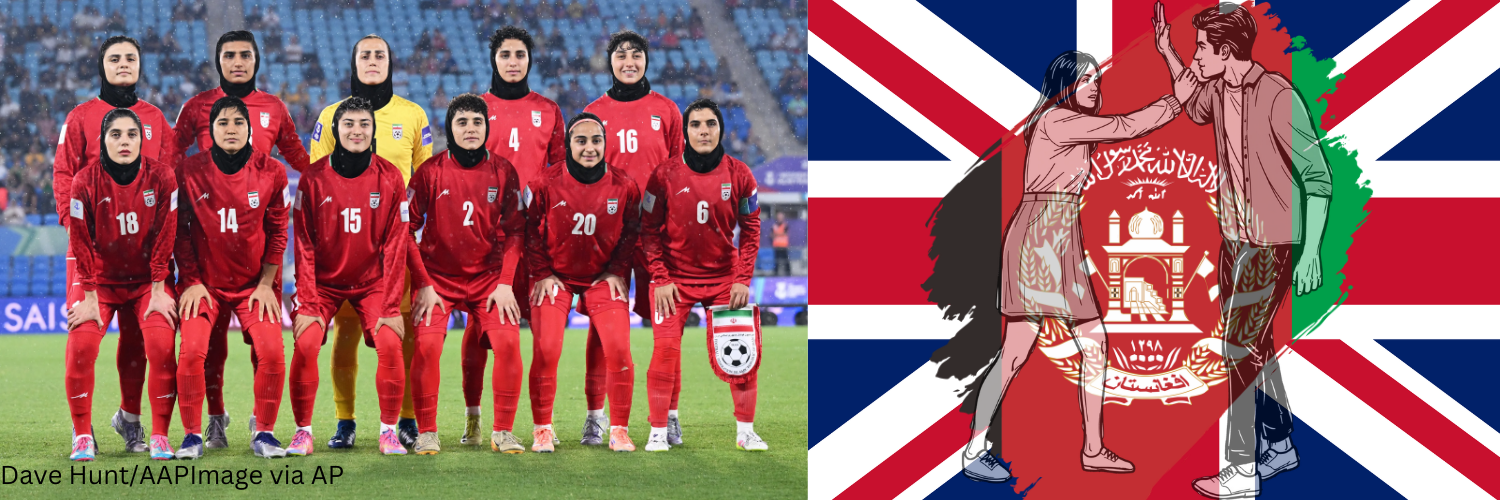
A UK Islamic charity has received “advice and guidance” from government regulators after a preacher made misogynistic comments. Back in October, the National Secular Society filed a complaint, reporting that Ahmed Shah of the Hatch End Islamic Centre told a congregation of young men that a woman must obey her husband without question or exception. He also claimed that Islam mandates that a woman must “do the housework” and “serve” her husband. The government’s “advice and guidance” bears no legal force and has been described by the National Secular Society as a “slap on the wrist” for a charitable organization which, by British law, is supposed to serve the public good.
A more extreme version of this attitude exists in Afghanistan, where a recent Taliban decree permits men to beat their wives “so long as they don’t break bones or leave visible, lasting wounds.” This is the logical conclusion of the idea that women exist only to “serve” their husbands. After all, what is one to do with a servant who refuses to submit to their role outlined by God? Qur’an 4:34 gives permission to use physical discipline in this case. Leaders of the Hatch End Islamic Centre are not fundamentally at odds with the Taliban on this question, only cautioning Muslims against “severely” beating their wives or hitting them in the face.
Lastly, it appears that most of the remaining members of the Iranian women’s soccer team have chosen to return from Australia to Iran. Iranian state media espoused the view that the women should be severely punished after they refused to sing the country’s national anthem at one of their games, prompting Australia to offer asylum. While two have stayed behind, five others who initially claimed asylum have joined their other team members in repatriation. Given last week’s images of a team member being led by the wrist to their departing bus, as well as Iran’s extensive pressure campaign to bring the women home (including threats to their family members), one wonders how much of this decision was genuinely voluntary. At this point, one can only hope they remain safe.
EXMNA Insights: Women Islamic History Couldn’t Contain
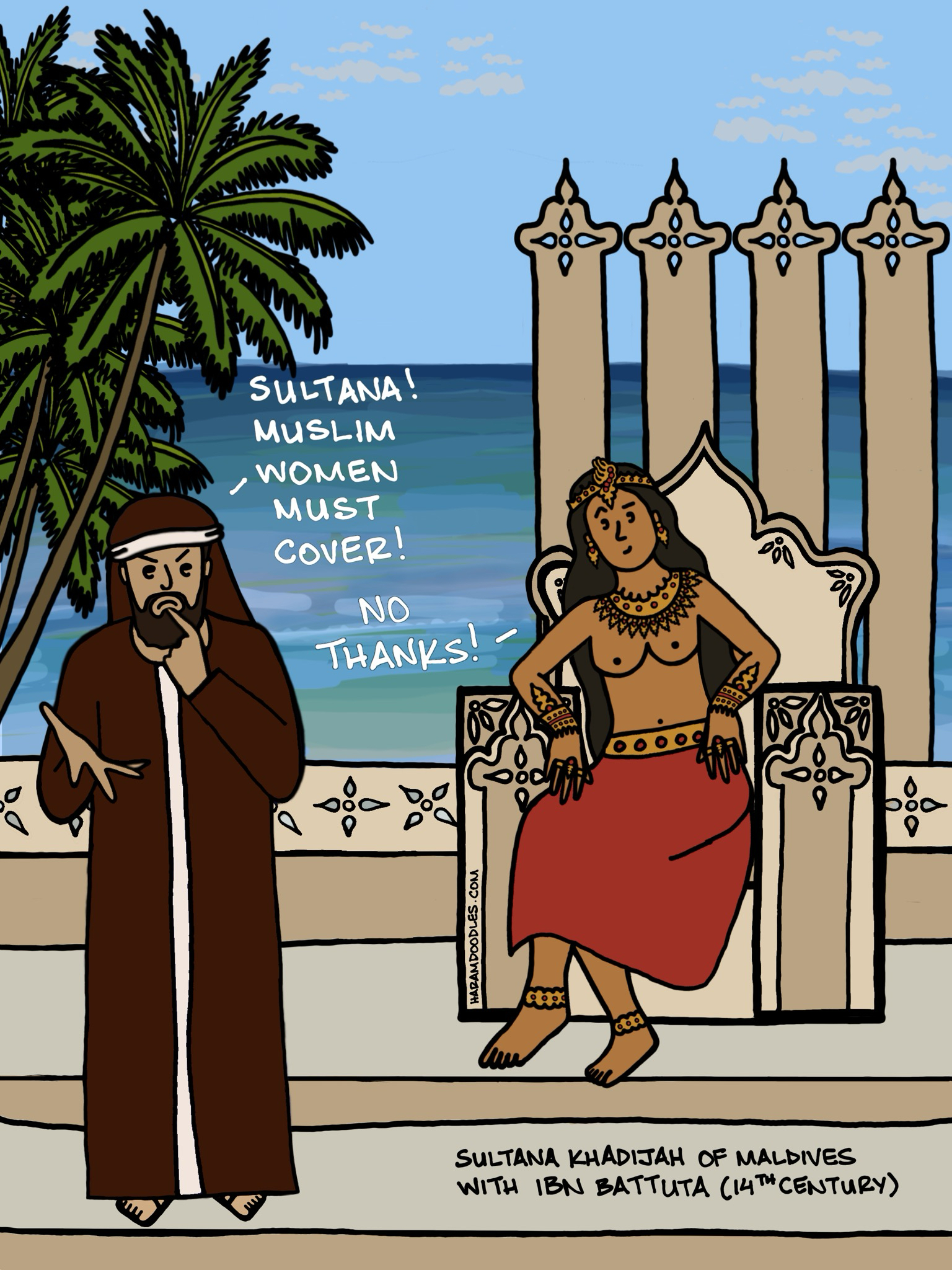
Artwork by: Haram Doodles
The Maldives in the 14th century had long become an Islamic state. After the conversion of the isles’ last Buddhist king to Islam in the 12th century, its kingdom became a sultanate. But local customs rarely disappear entirely, even when replaced by a new belief system. Nowhere is this more apparent than in the rule of the Maldivian “sultanas,” beginning in the 14th century with a ruler who shared a name with Muhammad’s first wife: Khadijah of the Maldives.
While Khadijah was the first woman to be named “Sultan of Land and Sea,” her ascension to power apparently came without much fanfare or controversy. The Maldives had a long history of Buddhism, separated from Islamic practice and thought for centuries. This is evident above all in the fact that a woman was allowed to rule at all, let alone for three decades as Khadijah did.
Khadijah’s rule was not uninterrupted; games of power and politics caused her to lose and regain the throne more than once. As always, these games were violent, and Khadijah’s hands were not bloodless. She had both her first and second husbands assassinated in bids to regain power, after both had deposed and usurped her. Such backstabbing was hardly unheard of, and the fact remains that Khadijah exercised power with all the legitimacy of a male sultan. She would pave the way for other women, like Raadhafathi (or Myriam) and Dhaain, to do the same after her.
During her rule, a Muslim traveler from North Africa named Ibn Battuta would discover just how consequential the islands’ historical insulation from Islam was. The very concept of a “sultana” was already a direct contravention of Muhammad’s guidance some 700 years prior: “Never will succeed such a nation as makes a woman their ruler.” But the standards of modesty to which Islam subjected women appeared not to have penetrated into the isles.
Khadijah did not only refuse to wear a head or face covering: she flouted even our own contemporary standards of modesty, wearing nothing above her waist. Such was the custom of all the islands’ women, Ibn Battuta wrote. He tried desperately to get the women of the isles, starting with their ruler, to cover up. Khadijah refused, and his efforts were almost entirely unsuccessful, with the exception of women who came to his court seeking legal rulings on religious matters.
Khadijah was no apostate. Her name was announced at Friday prayers and her rule was understood as Islamically legitimate by the inhabitants of the Maldives. She simply didn’t care for the burdens of modesty that her religion imposed on women, and it seems Maldivians were aligned with her on this point.
Ibn Battuta, for his part, seemed to enjoy his time in the Maldives. Other than their scandalous dress, he had only positive things to say about Maldivian women. “A woman in these islands,” he wrote, “would never entrust to anybody else the serving of her husband; she herself brings him food and takes away the plates, washes his hands and brings him water for ablutions and massages his feet when he goes to bed.”
It seems that, despite Maldivian women’s non-compliance with hijab rules, all could be forgiven so long as they remained pleasant and obedient domestic servants. It begs the question: does this reveal something deeper about the true motivation behind Islamic prescriptions for female “modesty”?
Until next week,
The Team at Ex-Muslims of North America
P.S. We’d love to hear from you! Share your feedback at [email protected].